
Scientist Discovered Why Most Traders Lose
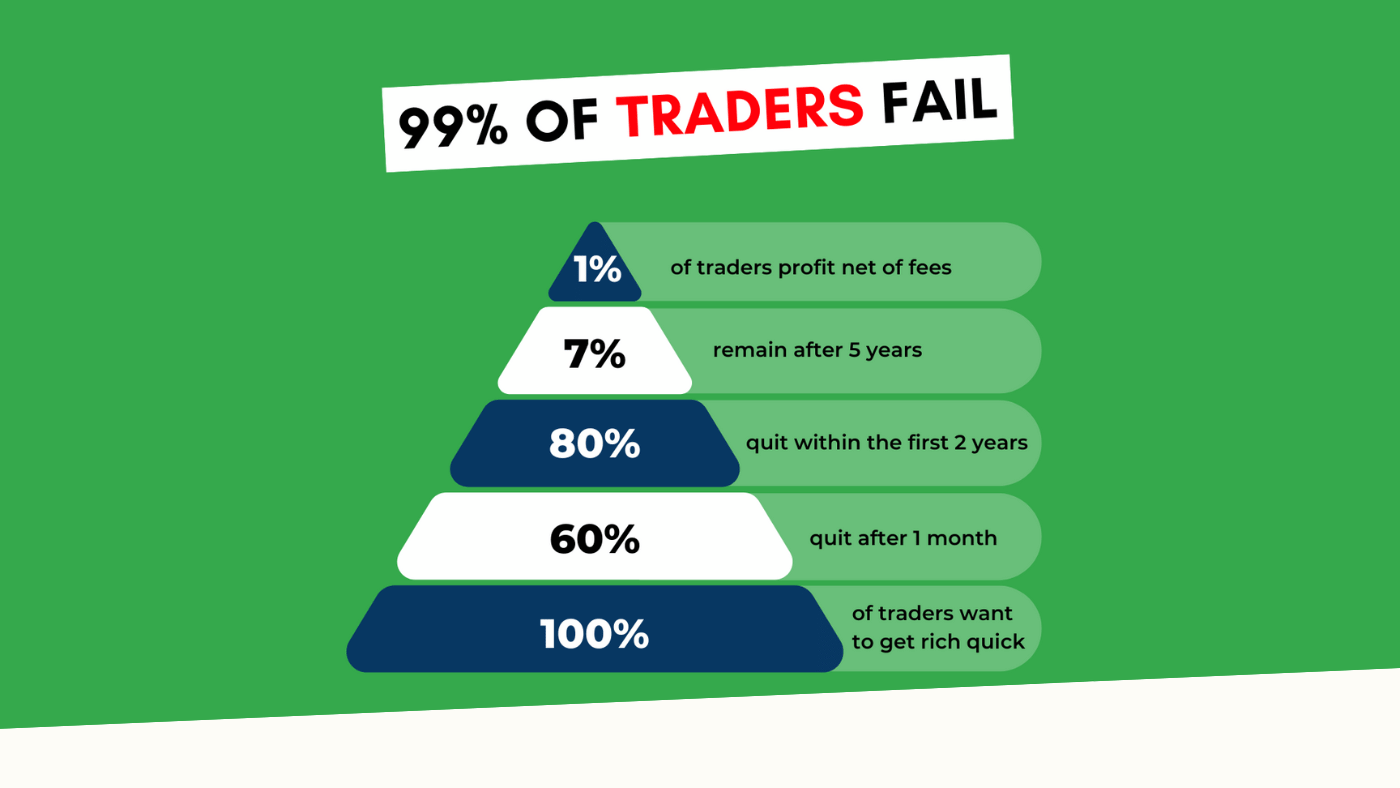
Why Most Traders Lose Money: What the Statistics Really Tell Us
Many people enter the world of forex trading believing it's a quick path to financial freedom. Social media often highlights luxury lifestyles, massive profits, and overnight success stories—but the reality is very different.
Research conducted over several years consistently shows that most traders lose money, not because trading is impossible, but because they lack education, discipline, patience, and proper risk management.
Let's look at some eye-opening statistics and, more importantly, understand what they actually mean for aspiring traders.
The Reality of Day Trading
Research suggests that the majority of new traders leave the market within just a few years.
Key Statistics
- Around 80% of day traders quit within their first two years.
- Nearly 40% stop trading within the first month.
- After three years, only about 13% continue trading.
- After five years, only approximately 7% remain active.
These numbers highlight one important lesson:
Success in trading requires long-term commitment, continuous learning, and patience.
Most Traders Lose More Than They Win
Many beginner traders focus only on making profits without understanding the importance of protecting their capital.
Studies show that:
- The average day trader loses money after transaction costs.
- Active traders often underperform passive investors.
- Only a very small percentage of traders generate consistent profits over many years.
This doesn't mean profitable trading is impossible—it means consistent profitability requires professional-level discipline.
Only a Small Percentage Become Consistently Profitable
Research indicates that only about 1% of day traders consistently earn profits after fees and trading costs.
Although profitable traders represent a very small percentage of all market participants, they account for a significant portion of overall trading activity.
What separates them from everyone else?
- Consistent trading plans
- Strong risk management
- Emotional discipline
- Continuous education
- Patience and experience
The Biggest Mistake: Letting Emotions Control Decisions
One of the most common behavioral mistakes among traders is known as the Disposition Effect.
Research shows that traders are:
- More likely to sell profitable trades too early.
- More likely to hold losing trades for too long.
This happens because:
- Fear encourages traders to lock in small profits quickly.
- Hope convinces traders that losing positions will eventually recover.
Unfortunately, this habit often limits profits while allowing losses to grow.
Overconfidence Can Be Expensive
Another common finding across trading research is that traders often become overconfident after a few successful trades.
After experiencing early wins, many traders begin to:
- Increase position sizes.
- Trade more frequently.
- Ignore risk management.
- Abandon their trading plans.
In many cases, this overconfidence leads to significant losses.
Successful traders understand that one profitable trade doesn't prove a strategy works forever.
More Trading Doesn't Mean More Profits
Many beginners believe they need to trade every day.
In reality, professional traders often spend more time waiting than trading.
Studies show that excessive trading generally leads to:
- Higher transaction costs.
- More emotional decisions.
- Increased stress.
- Lower overall returns.
Remember:
The goal isn't to trade more—it is to trade better.
Trading Is Not Gambling
Some traders approach the financial markets the same way people approach casinos or lotteries.
Research has found similarities between gambling behavior and poor trading habits, including:
- Chasing losses.
- Taking excessive risks.
- Seeking excitement rather than consistency.
- Ignoring proper money management.
Successful trading is the exact opposite.
Professional traders focus on:
- Probability
- Risk management
- Consistency
- Long-term growth
- Data-driven decision-making
Trading should never be treated as entertainment.
The Importance of Risk Management
Nearly every successful trader agrees on one principle:
Protect your capital first.
Good risk management includes:
- Risking only 1–2% of your account per trade.
- Always using a stop-loss.
- Maintaining favorable risk-to-reward ratios.
- Avoiding emotional decisions.
- Accepting small losses as part of trading.
Without risk management, even the best strategy will eventually fail.
Why Many Traders Keep Losing
Interestingly, studies show that many traders continue trading even after years of consistent losses.
Instead of improving their skills, they often:
- Increase their risk.
- Change strategies constantly.
- Blame the market.
- Chase quick profits.
- Ignore their mistakes.
Successful traders do the opposite.
They review every trade, maintain detailed journals, and continuously refine their trading process.
Characteristics of Successful Traders
Profitable traders generally share several common habits:
- They follow a written trading plan.
- They maintain realistic expectations.
- They continuously improve their knowledge.
- They control their emotions.
- They manage risk consistently.
- They focus on long-term consistency rather than short-term excitement.
- They understand that losses are a normal part of trading.
Success comes from discipline—not luck.
Practical Lessons Every Beginner Should Remember
Before placing your next trade, ask yourself:
- Do I have a clear trading plan?
- Have I defined my stop-loss?
- Am I risking only a small percentage of my capital?
- Does this trade match my strategy?
- Am I trading because of analysis—or because of emotion?
If you cannot confidently answer these questions, it may be better to wait.
Remember, not trading is sometimes the best trading decision.
Trading Is a Skill, Not a Shortcut
Many people enter trading expecting to become wealthy within a few months.
In reality, trading is a professional skill that requires:
- Education
- Practice
- Experience
- Discipline
- Emotional control
- Continuous learning
Just as doctors, engineers, and pilots spend years mastering their professions, successful traders invest time in developing their skills before expecting consistent results.
Final Thoughts
The statistics clearly show that most traders fail not because the markets are impossible to trade, but because they approach trading with unrealistic expectations and poor habits. Emotional decision-making, overtrading, lack of risk management, and the desire for quick profits are the biggest reasons traders lose money over time.
The encouraging news is that these mistakes are entirely avoidable. By focusing on education, maintaining a disciplined trading plan, managing risk effectively, and treating trading as a long-term profession rather than a shortcut to wealth, you dramatically increase your chances of success.
At Profit & Profit Academy, we believe successful trading starts with the right mindset. Our training programs emphasize practical skills, disciplined risk management, and proven trading strategies to help students build consistency and confidence. Remember, becoming a profitable trader isn't about getting rich overnight—it's about making smart decisions consistently over time.