
How To Use The Donchian Channel For Breakout
Donchian Channel Trading Strategy: How to Find Better Breakout Entries
The Donchian Channel is one of the oldest and most trusted trend-following indicators in technical analysis. Developed by legendary trader Richard Donchian, this indicator helps traders identify breakouts, trend direction, and potential entry opportunities by tracking the highest high and lowest low over a selected period.
Many successful trend-following traders use the Donchian Channel because it removes much of the guesswork from identifying breakout opportunities. However, not every breakout leads to a profitable trade. False breakouts occur frequently, especially during low-volatility or sideways market conditions.
The key to success is filtering low-quality signals and focusing only on high-probability trades.
What Is the Donchian Channel?
The Donchian Channel consists of three lines:
- Upper Band – The highest price over a selected period.
- Lower Band – The lowest price over the same period.
- Middle Band – The average of the upper and lower bands.
The most common setting is a 20-period Donchian Channel, although traders often adjust the period depending on their strategy and timeframe.
Why Traders Use the Donchian Channel
The Donchian Channel helps traders:
- Identify breakout opportunities.
- Follow strong market trends.
- Recognize consolidation phases.
- Detect potential trend reversals.
- Improve entry and exit decisions.
Because it is based entirely on price, the Donchian Channel works well with price action and trend-following strategies.
Step 1: Find High-Momentum Breakouts
Not every breakout deserves to be traded.
Many false breakouts occur simply because the market lacks enough momentum to continue moving in the breakout direction.
One of the best ways to improve breakout quality is by confirming momentum.
Use the RSI as a Momentum Filter
The Relative Strength Index (RSI) can help determine whether the breakout has sufficient strength.
Strong Breakout Characteristics
- RSI shows increasing momentum.
- Price breaks the Donchian Channel with strong candles.
- Volume supports the move.
- Market structure aligns with the breakout.
Weak Breakout Characteristics
- RSI shows weak momentum.
- Bearish or bullish divergence appears.
- Small candles near resistance or support.
- Price quickly returns inside the channel.
By combining the Donchian Channel with RSI, traders can eliminate many low-quality breakout signals.
Bonus Tip for Reversal Traders
The Donchian Channel isn't only useful for breakout traders.
Reversal traders can also use it to identify false breakouts.
When price briefly breaks the Donchian Channel but RSI shows weak momentum or divergence, the breakout may fail, creating a potential reversal opportunity.
This combination can help traders identify:
- Bull traps
- Bear traps
- Failed breakouts
- Mean reversion setups
Step 2: Improve Entries with a Trend Filter
Another effective way to increase trade accuracy is by trading only in the direction of the overall trend.
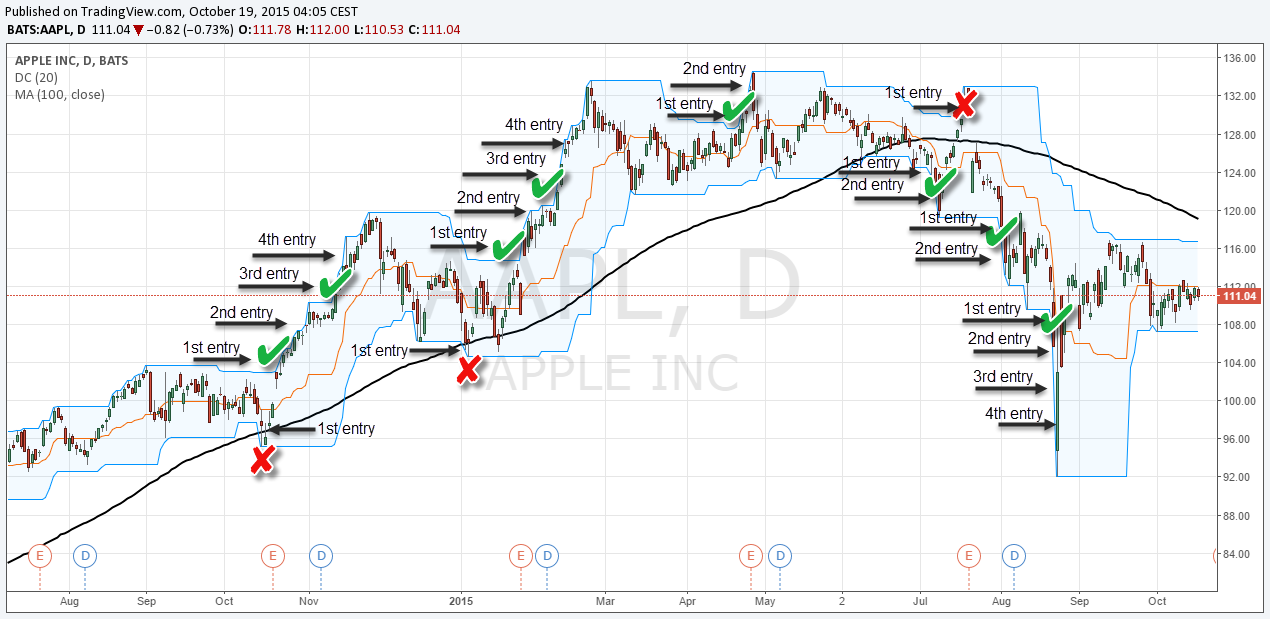
One of the simplest methods is using a 100-period Moving Average.
Trading Rules
Price Above the 100 MA
- Look only for buy breakouts.
- Ignore sell signals.
Price Below the 100 MA
- Look only for sell breakouts.
- Ignore buy signals.
This simple filter removes many low-probability trades that go against the dominant market trend.
Many professional traders, including renowned trend follower Marty Schwartz, have emphasized the importance of using moving averages to align trades with the prevailing trend.
Why Trend Filters Work
Markets spend more time trending than many traders realize.
Trading in the direction of the dominant trend generally offers:
- Higher probability setups.
- Fewer false breakouts.
- Better risk-to-reward opportunities.
- Greater consistency.
A trend filter helps traders avoid taking trades during weak or uncertain market conditions.
Combining Multiple Indicators
No single indicator is perfect.
The Donchian Channel becomes much more effective when combined with complementary tools such as:
- RSI
- Moving Averages
- Price Action
- Market Structure
- Volume Analysis
- Support and Resistance
When multiple factors support the same trade idea, confidence in the setup increases.
Position Sizing for Breakout Trading
Finding good entries is only part of successful trading.
Proper position sizing is equally important.
One effective technique used by trend-following traders is called Scaling In.
What Is Scaling In?
Scaling In means entering a trade gradually instead of opening the full position immediately.
For example:
- Enter part of your planned position when the breakout occurs.
- Add to the trade only if price continues moving in your favor.
- Adjust your stop-loss to protect profits as the trade develops.
This approach reduces risk while allowing traders to maximize gains during strong trends.
Benefits of Scaling In
Smaller Losses on False Breakouts
If the breakout fails, only a small portion of your intended position is exposed.
This helps minimize losses.
Larger Profits on Strong Trends
When the breakout succeeds, additional positions can be added as momentum builds.
This allows traders to fully benefit from sustained market trends.
Scaling In is widely used by professional traders because it balances risk and reward more effectively than entering a full position all at once.
Common Beginner Mistakes
Many traders misuse the Donchian Channel by:
- Trading every breakout.
- Ignoring overall market trends.
- Entering without momentum confirmation.
- Risking too much on a single trade.
- Moving stop-losses emotionally.
- Adding to losing positions instead of winning ones.
Avoiding these mistakes can significantly improve long-term consistency.
Best Practices for Using the Donchian Channel
To get the most from this indicator:
- Trade breakouts with strong momentum.
- Confirm entries using RSI or another momentum indicator.
- Use a moving average to identify the overall trend.
- Wait for candle confirmation before entering.
- Scale into winning trades when appropriate.
- Follow a disciplined risk management plan.
- Keep a trading journal to review your breakout performance.
Remember, consistency comes from following a repeatable process—not from chasing every market move.
Final Thoughts
The Donchian Channel is a simple yet powerful indicator that helps traders identify breakout opportunities and follow market trends with greater confidence. However, the real strength of this strategy comes from combining the Donchian Channel with momentum confirmation, trend filters, disciplined position sizing, and sound risk management.
Rather than relying on breakouts alone, traders should build a structured trading plan that filters out low-probability setups and focuses only on high-quality opportunities. By combining technical tools that complement each other and aligning them with your trading style, you can improve both the consistency and reliability of your trading decisions.
At Profit & Profit Academy, we teach traders how to apply the Donchian Channel alongside practical price action techniques, trend analysis, and professional risk management. With the right strategy and disciplined execution, the Donchian Channel can become a valuable part of a well-rounded trading system.